Japan's 2024 AI White Paper: Stage II, Governance, and the Road to an AI-Friendly Economy
Inside Japan's 2024 AI White Paper: Stage II strategy, AI Guidelines for Business, AISI, and what it means for public affairs and corporate AI strategy in Japan.

Japan has made a deliberate choice in the global AI policy debate: position itself as the most AI-friendly major economy while building a credible safety architecture around high-risk deployments. The 2024 AI White Paper, issued by the Liberal Democratic Party’s AI Project Team, is the clearest articulation of that approach. It frames Japan’s entry into what the paper calls “Stage II”, the phase in which AI moves from experimentation into broad industrial and public-sector utilisation.
For multinationals building or deploying AI systems in Japan, and for corporate affairs teams tracking public policy in Japan on technology regulation, the 2024 White Paper remains the anchor document. The frameworks it described have been steadily implemented through 2025 and 2026 via METI, the Cabinet Office, the Digital Agency, and the AI Safety Institute.
Japan’s 2024 AI White Paper
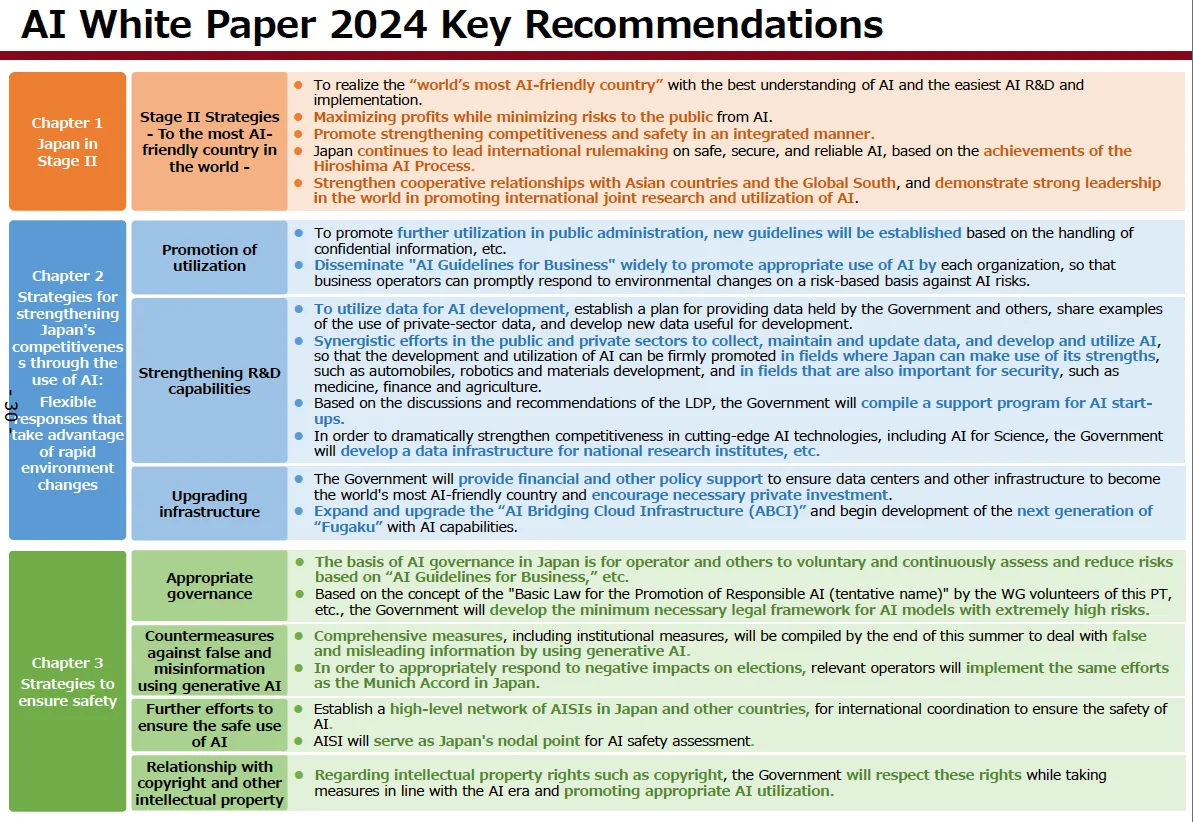
Source: Japan AI White Paper 2024
The full text of the paper is available here. It builds on the LDP AI Project Team’s 2023 report, the so-called “Big Bang” white paper, which first set out Japan’s posture of promoting AI development while building the regulatory and institutional infrastructure to manage risk.
From “Big Bang” to “Stage II”
The 2023 paper argued that Japan needed to move quickly: build domestic foundation models, expand compute capacity, establish governance guidelines, and create AI-focused institutions. Much of that agenda has since been executed. The AI Guidelines for Business were published. The AI Safety Institute (AISI) was established in early 2024 under the Information-technology Promotion Agency. Domestic foundation-model efforts (led by firms including NTT, SoftBank, and Sakana AI, and supported by METI and NEDO) are operational.
“Stage II” is the next phase. The White Paper frames it as a twofold mission: strengthen Japan’s AI competitiveness and ensure safety. The two are treated as complementary rather than in tension, a deliberate contrast with the EU’s more restriction-forward AI Act and the United States’ more sector-specific posture.
Strengthening competitiveness
The competitiveness agenda has three sub-pillars.
Promoting utilisation
The paper calls for widespread sharing of advanced AI use cases across industries, new guidelines for handling confidential and personal information in AI workflows, and for the public sector to lead by example in deployment. It recommends establishing Chief AI Officers (CAIOs) in major organisations, running hackathons and ideathons to accelerate practical innovation, and using government procurement as a signalling mechanism.
For companies, the practical read is that Japan is trying to normalise AI deployment at operational scale, not just in R&D. That creates procurement and partnership opportunities: particularly around enterprise AI, public-sector digital transformation, and industry-specific model tuning.
Strengthening R&D capabilities
Japan has explicitly committed to developing AI models tailored to its linguistic and cultural context, on the view that general-purpose foreign foundation models do not adequately capture Japanese-language nuance, regulatory content, or domain-specific knowledge. The White Paper calls for industry-academia collaboration, focused support for AI startups, and investment in high-quality Japanese-language training data.
Commercial implication: foundation-model developers, cloud providers, and data-infrastructure firms have a policy environment that is actively encouraging Japan-specific development: whether through domestic partnerships, joint ventures, or localised deployments.
Enhancing infrastructure
Japan has committed to expanding its AI compute base. The AI Bridging Cloud Infrastructure (ABCI) has been upgraded, and METI has announced subsidies to support domestic data-centre and GPU-cluster construction. The White Paper emphasises energy-efficient, high-performance computing, a link back to the Basic Energy Plan, since AI-driven power demand is one of the factors pushing nuclear restarts and grid expansion.
Ensuring safety
The safety pillar is where Japan’s approach becomes globally distinctive. Rather than a horizontal, binding AI law, Japan has opted for a hybrid framework: soft-law guidelines for most AI applications, with targeted legal instruments for high-risk use cases.
Governance through the AI Guidelines for Business
The AI Guidelines for Business, maintained by METI and the Ministry of Internal Affairs and Communications (MIC), set out expected practices for developers, providers, and users of AI systems. Compliance is largely voluntary, with reputational and procurement incentives providing the enforcement gradient. The approach is designed to move faster than legislation and to remain adaptable as the technology evolves.
For firms operating in Japan, the Guidelines are not optional in practice. They define the expected standard of care for AI deployment and are referenced in public-sector procurement, investor-due-diligence processes, and emerging liability discussions.
Countermeasures against disinformation
With generative AI accelerating the volume and realism of synthetic content, the White Paper calls for authentication technologies (such as content provenance and watermarking), public-facing literacy initiatives, and coordination with platforms on fact-checking and takedown processes. The issue connects to election integrity, national security, and consumer protection, all of which have their own ministerial stakeholders.
The AI Safety Institute (AISI)
The AI Safety Institute is the institutional hub for Japan’s safety work. It coordinates technical evaluation of frontier models, publishes red-teaming guidance, trains specialised human resources, and represents Japan in international AI safety dialogues, including work with the UK AI Security Institute and the US AI Safety Institute. AISI has grown substantially since 2024 and is a central counterpart for foreign AI developers deploying advanced models in Japan.
Intellectual property
Japan’s IP posture under the White Paper is pragmatic: protect the rights of creators while maintaining the broad permissions for AI training established under Article 30-4 of the Copyright Act. The White Paper calls for continued stakeholder dialogue and ecosystem development, rather than wholesale legislative change. That position has faced sustained pressure from creative industries but has largely held.
What this means for companies operating in Japan
For any company building, deploying, or procuring AI in Japan, the White Paper, and its ongoing implementation, has direct commercial implications.
- The AI Guidelines for Business are the baseline. Product, compliance, and procurement teams should map their AI practices against the Guidelines and be prepared to articulate alignment.
- AISI is the relevant technical interlocutor. For frontier-model providers, early engagement with AISI on evaluation and red-teaming is strategically important.
- Japan-specific model work is incentivised. Localisation, Japanese-language fine-tuning, and partnerships with domestic firms are supported by policy and procurement signals.
- Data-centre and compute investment is welcomed. METI and the Digital Agency are actively courting hyperscaler and domestic compute investment, with subsidies and siting support available.
- High-risk AI will see targeted regulation. Healthcare, autonomous systems, and financial services should expect sector-specific AI rules layered on top of the general Guidelines.
Why this matters for public affairs in Japan
Japan’s AI policy is a fast-moving, multi-ministry terrain. METI, MIC, the Cabinet Office, the Digital Agency, the Personal Information Protection Commission, AISI, and the relevant Diet committees all have equities in how the framework evolves. That complexity is precisely where government relations in Japan becomes a strategic input rather than a support function.
Gemini Group works with AI developers, cloud providers, and enterprise AI adopters to navigate Japan’s policy landscape: tracking Guidelines updates, engaging with AISI and the relevant ministries, and building positions that align commercial objectives with Japan’s Stage II priorities. Contact us to discuss how your organisation can shape and respond to Japan’s AI policy environment.
Frequently asked questions
- What is Japan's AI White Paper?
- It is the policy document produced through the ruling party's AI project team setting out Japan's strategic direction on artificial intelligence. The 2024 edition framed the country as moving into what it called Stage II: past the initial excitement about generative AI and into the harder work of deployment, competitiveness and governance. It is not legislation, but it signals what legislation and budget allocation will follow.
- How does Japan regulate AI?
- Japan has deliberately chosen a lighter-touch, innovation-first approach rather than the EU's comprehensive risk-tiered prohibitions. Its framework rests on guidelines for business, voluntary commitments, and sector regulators applying existing law, supported by an AI Safety Institute for evaluation. The legislation that has passed emphasises promotion and coordination rather than penalties, which is the single most important difference for companies comparing Japan with Europe.
- How is Japan's AI approach different from the EU AI Act?
- The EU AI Act is binding, risk-tiered and carries substantial penalties. Japan's framework is principally promotional: it sets expectations through guidelines and relies on existing sector law for enforcement. A company that has built compliance for the EU regime will generally exceed what Japan requires, but should not assume the categories map across, because Japan's obligations attach through sector regulators rather than a central AI authority.
- What is Japan's AI Safety Institute?
- It is the body established to evaluate AI safety, develop testing methodology and support standards work, positioned as Japan's counterpart to similar institutes in the UK and US. Its role is evaluative and advisory rather than regulatory: it does not license or fine, but its assessments inform what sector regulators and the guidelines eventually expect.