
How Does Lobbying Work in Japan?
Stakeholders in Japan often engage ministries and policymakers early—through meetings, written submissions, and sustained follow-up.
Key takeaways
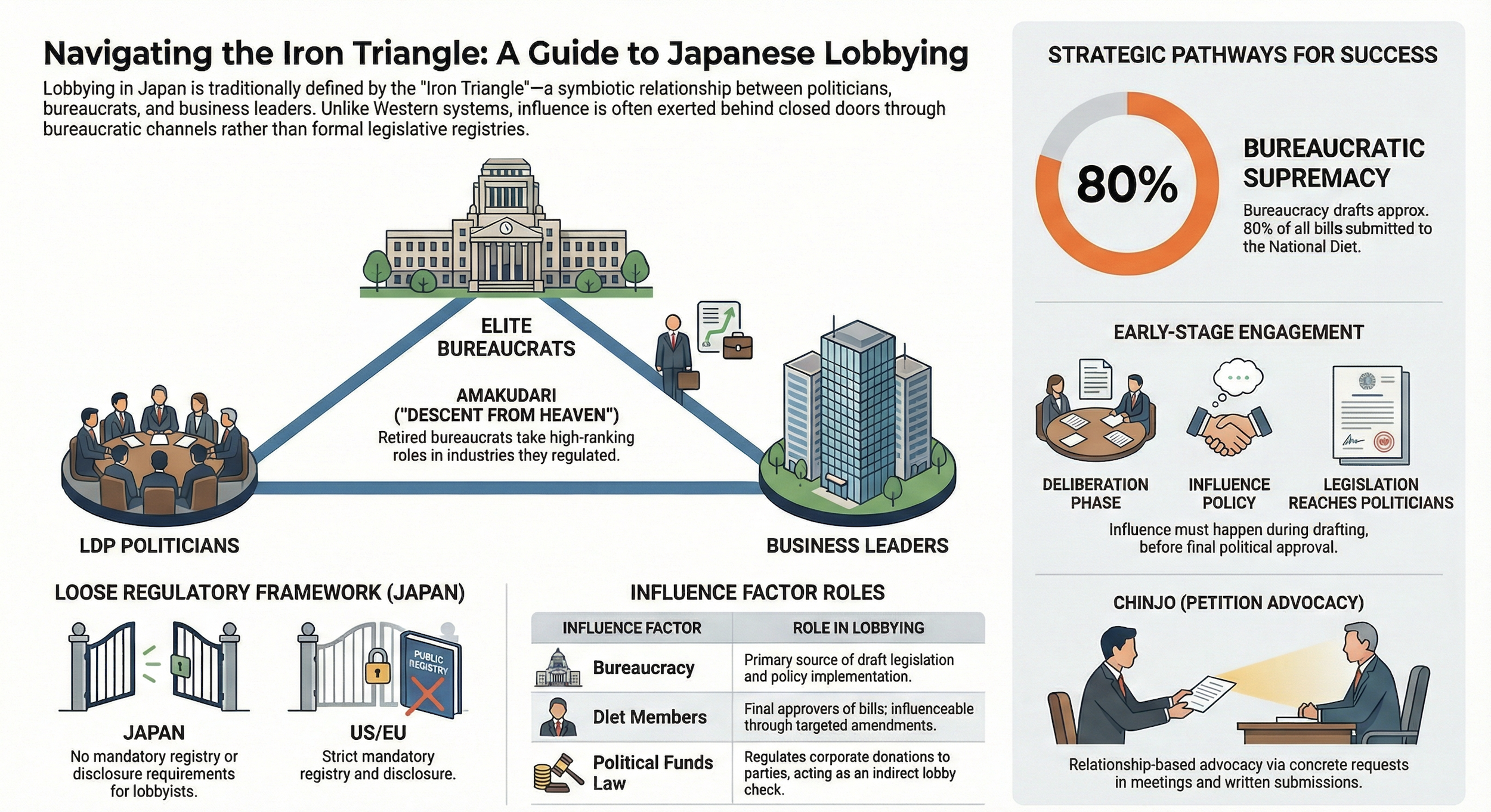
Traditionally, lobbying in Japan has been the domain of the Iron Triangle: politicians, bureaucrats and business leaders, with negotiations behind closed doors.
A prominent practice resulting from the triangle is amakudari, where retiring bureaucrats “descend from Heaven” into cozy jobs at the private organizations they used to regulate.
Effective lobbying in Japan can be achieved by various means, including: petition-style advocacy, known as chinjo; engaging with the bureaucracy during the lawmaking process; and navigating a regulatory system that is loose but tightening.
For any foreign player planning an entrance into the Japanese market, knowledge of the intricacies of lobbying in Japan is a must. Public policy affects all companies doing business in the country, even international ones, so a strong understanding of public affairs and government relations is not just an edge but a necessity.
Lobbying in Japan can follow different patterns than those elsewhere, requiring a tailored strategy and a structured approach to ensure success. While the present Japanese political landscape might be in flux, the underlying machinery of the state remains firmly in place.
Let’s take a look at the history of Japanese lobbying, the idiosyncrasies of the practice in the country, and how foreign actors should approach it.
How lobbying works in Japan
A history of lobbying in Japan
What is the Iron Triangle?
Traditionally, lobbying in Japan happened behind the scenes: the secretive trade of a triumvirate of politicians, bureaucrats and business leaders known as the Iron Triangle. These networks of power smoothed out the coordination of policies between public and private interests, resulting in a symbiotic relationship that persists to this day, albeit in a changing state.
The political side of the triangle has been dominated by the Liberal Democratic Party (LDP) due to its almost continuous grip on power in the National Diet. However, even when the Democratic Party of Japan (DPJ) wrestled control of the government from the LDP in 2009 on a platform that promised to do away with vested interests, the new party eventually perpetuated the system. The DPJ was no match for Japan’s entrenched bureaucracy.
While the Iron Triangle was envisioned as a mechanism to ensure efficient cooperation between government and big business, it had the undesirable side effect of facilitating corruption and encouraging pork barrel spending. Scandals such as a 2017 affair involving Education Ministry officials being placed in cozy positions atop Japan’s elite universities (a practice known as amakudari) became the catalyst for increased demands for transparency and tighter regulation.
While present day Japan has more stringent disclosure requirements and greater oversight, traditional bias towards closed-door dealmaking and consensus-building continues to influence lobbying.
What is Amakudari (天下り)?
Amakudari (literally, “descent from Heaven”) refers to the practice of reemployment of retired bureaucrats by private and nongovernmental organizations. Since these organizations are in the sectors which the bureaucrats used to regulate, this form of golden parachute has faced strong criticism for decades due to the resulting conflicts of interest.
This sort of revolving door offers benefits to both sides. For bureaucrats, who are expected to retire from their ministry or agency relatively early (usually, by their late 50s), parachuting into a cozy position in the private sector provides job security and the opportunity to leverage their expertise. On the other hand, organizations obtain someone who they hope can act as liaison with the government department that regulates them, providing a direct avenue for lobbying.
Struggling organizations hoping for a government windfall are prime amakudari employers, such as (as in the example above) Japanese universities, which are grappling with falling enrollment due to the low birthrate.
While regulations have been tightened, such as a 2008 revision to the National Public Service Act, the exploitation of loopholes and a failure to address the root causes of amakudari have made its elimination difficult.
How to approach lobbying in Japan?
Chinjō (陳情)
In the context of corporate government relations, chinjo (陳情) refers less to a formal petition procedure and more to petition-style advocacy: making a concrete request to policymakers or officials through meetings, written submissions, and follow-up engagement. The emphasis is on clearly stating the ask, explaining the rationale, and building sufficient support so the request is taken up inside the relevant institutions.
Chinjo is typically used to encourage an authority to take, adjust, or refrain from measures within its jurisdiction. In practice, that can mean seeking a change in policy direction, shaping draft rules before they are finalized, clarifying interpretations, or requesting transitional arrangements. This approach is used not only by individuals but also by companies, industry groups, and foreign-affiliated firms, often working through established relationship channels.
Note: The term chinjo can also refer to a formal submission to an elected assembly, with locally defined filing requirements and procedures (often handled by an assembly secretariat). This article uses chinjo in the broader GR sense of petition-style advocacy, not necessarily a formal filing.
Bureaucratic supremacy
It is vital to understand that the vast majority of policymaking in Japan is done by the bureaucracy, not the politicians. The Japanese civil service is responsible for roughly around 80% of bills submitted to any given Diet session, so engaging the bureaucrats is essential for any lobbyist hoping for success.
It’s recommended to start as early as possible, when the government agenda is being worked out and the bureaucracy’s influence is at its highest. During this time, the ministries and agencies hold deliberations with stakeholders affected by the administration’s policy goals. Such discussions are an all-important opportunity for lobbyists to influence draft legislation before it reaches politicians for approval.
That is not to say that Diet members don’t initiate legislation. Lawmakers also consult with a variety of actors when drafting laws, including impacted companies. These stakeholders are not excluded from the legislative amendment process, and while key elements of the bills are rarely changed, they can still influence policy updates and achieve a more targeted implementation.
Lobbying success will depend on how well-prepared stakeholders come to these negotiations. A proposed revision has a higher chance of being incorporated into the final draft bill if it’s backed by credible data and research, and enjoys some measure of political and public support.
Loose regulation
It might come as a surprise after reading about legislation to curtail amakudari, but Japan lacks tight regulations specifically aimed at lobbying activities. Unlike jurisdictions like the US and the EU, lobbyists in Japan are not required to register with the government or file reports in line with disclosure rules.
Still, some Japanese laws and regulations indirectly impact the workings of lobbyists in the country. An important one is the Political Funds Control Law, which regulates political donations flowing from corporations and interest groups into individual politicians and political parties. The Public Office Election Law is another to note, which affects how stakeholders can support their preferred candidates and parties by regulating election campaigns and political advertising. Recently, the law has come under fire as too lenient due to a major scandal involving underreporting of campaign funds in the LDP, so future tightening is a possibility.
Conclusion
As the Japanese public becomes less tolerant of so-called “money in politics” scandals resulting from a deep-rooted lack of transparency, the regulatory environment affecting lobbying in the country will continue to change. Efforts for greater disclosure in recent years are likely to continue, particularly if the LDP loses control of the government in a future election.
International influence cannot be discounted, with developments such as the Trump administration’s conflicts of interest and the EU’s crackdown on big tech possibly having some influence in Japan. Still, foreign actors’ need to tailor their approach to local sensibilities will remain a necessity. GR/PA strategies must be localized to be truly effective. Comprehending, and adapting, to Japan’s unique landscape will set you up for success in your lobbying efforts.
If you found this overview useful and want more regular insights into Japan’s politics and public policy, sign up to our mailing list and stay ahead of the developments shaping Japan’s future.
Frequently Asked Questions (FAQ)
Q: What’s the difference between lobbying in Japan and lobbying in the US/EU?
A: Japan is often described as having fewer lobbying-specific requirements (like universal registration and activity reporting) than the US/EU, while influence is more commonly exercised through consultations, industry groups, and ministry-centered processes. The constraints tend to show up indirectly through political finance rules, ethics expectations, procurement rules, and enforcement in adjacent areas rather than a single dedicated lobbying statute.
Q: Is there an official definition of “lobbyist” in Japan?
A: There isn’t one universally used definition in the way some jurisdictions define “lobbyist” for registration regimes. In practice, many actors engage government: companies, trade associations, law firms, consultants, think tanks, NGOs, and local stakeholders. That breadth is one reason “lobbying” is often discussed in Japan as a set of behaviors and channels rather than one regulated profession.
Q: What’s the difference between amakudari and a normal revolving door?
A: “Revolving door” is a general term for movement between regulator and regulated. Amakudari is a Japan-specific pattern historically associated with senior officials retiring and taking roles in sectors they previously oversaw. The controversy is less about job switching itself and more about perceived preferential access, conflicts of interest, and blurred regulator–industry boundaries.
Q: Is Japan becoming stricter about “money in politics”?
A: Public attention to political finance transparency has increased, and reforms continue to be debated in response to reporting scandals and perceived loopholes.