
What is Japan’s Proportional Representation System?
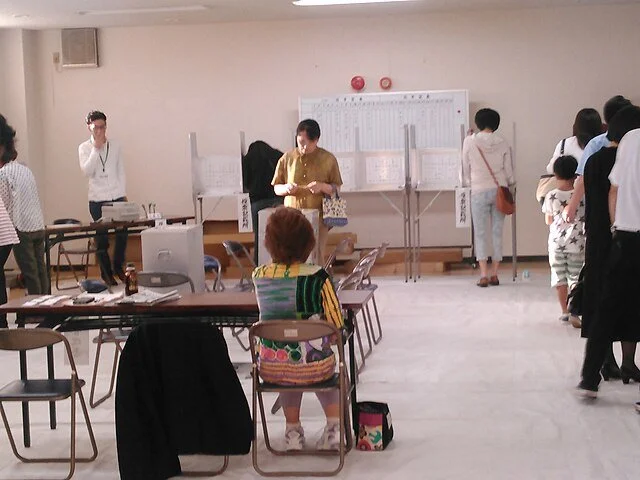
Voters casting their ballots at a Japanese polling station. In the parallel voting system, voters receive two separate ballots: one to select an individual candidate for their single-seat district, and another to vote for a political party (Lower House) or candidate/party (Upper House) via proportional representation.
Key Takeaways
The proportional representation system was established in Japan in 1993 with the goal of ensuring fairer elections and increased access for smaller parties.
In the Lower House, 176 members are elected in closed party lists out of 11 regional blocks.
In the Upper House, 100 members (50 per election) are elected in open party lists out of a single nationwide block.
The governing coalition is currently discussing a 10% seat reduction in the Lower House, which if passed would cut 20 proportional representation seats.
The government coalition of the Liberal Democratic Party (LDP) and the Japan Innovation Party (JIP) has been discussing a bill to cut the number of seats in the powerful Lower House by 10%. While it never saw the light of day during the 2025 extraordinary session, the specter of political reform will still linger as the Diet heads into 2026.
The proportional representation method in particular has found itself in the crosshairs, initially targeted to account for all the cut seats. However, dissent from smaller opposition parties who depend on those seats quickly derailed that plan.
How did we get here? Let’s take a look at how the system came about, how it works in national elections, and how it will be affected by the seat reduction initiative.
A history of proportional representation in Japan
Japan used a single non-transferable vote system for national elections until 1993, with multiple candidates (usually between three and five) elected in each district. Since the LDP was the only party large enough to field several candidates in a single district, the opposition accused the system of hindering government change and ensuring LDP dominance.
When an eight-party opposition coalition led by the Japan New Party wrestled control of the government from the LDP in the 1993 general election, the new administration pursued political reform. Their aim was establishing a system that would lead to frequent changes of government in a two-party system (as seen through the brief reign of the Democratic Party of Japan from 2009-2012), and to elections that would focus more on parties and their policies and less on individual politicians and their connections.
While the initial plan was a single-seat constituency system for the Lower House, discussions led to a compromise that resulted in a combination of single-seat constituencies with first-past-the-post voting, and party-list proportional representation blocks, which has been in place since 1994 and in use since the 1996 general election.
How does proportional representation work in elections for the House of Representatives?
Voters in a Lower House election receive two ballots, one to vote for an individual candidate in their district, and another to vote for a party in their regional block via proportional representation.
Out of 465 seats, 176 are picked from 11 proportional representation blocks. Most of these regional blocks comprise several prefectures, except Hokkaido and Tokyo, which include only their own prefecture.
Proportional representation districts (seats per district)
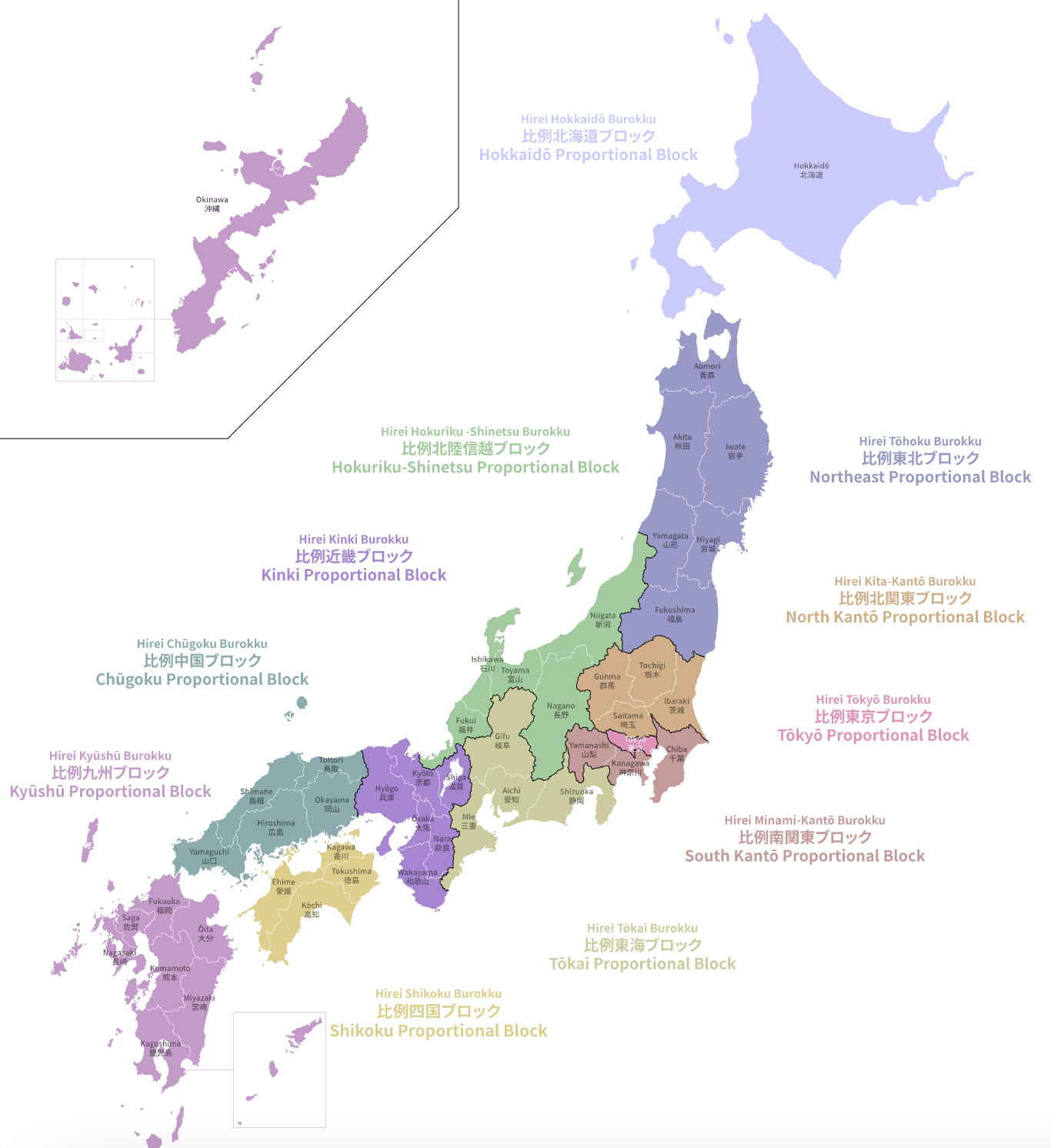
Hokkaido (8)
Hokkaido
Northeast (12)
Aomori, Iwate, Miyagi, Akita, Yamagata, Fukushima
North Kanto (19)
Ibaraki, Tochigi, Gunma, Saitama
Minami-Kanto (23)
Chiba, Kanagawa, Yamanashi
Tokyo (19)
Tokyo
Hokuriku-Shin'etsu (10)
Niigata, Toyama, Ishikawa, Fukui, Nagano
Tokai (21)
Gifu, Shizuoka, Aichi, Mie
Kinki (28)
Shiga, Kyoto, Osaka, Hyogo, Nara, Wakayama
Chugoku (10)
Tottori, Shimane, Okayama, Hiroshima, Yamaguchi
Shikoku (6)
Tokushima, Kagawa, Ehime, Kochi
Kyushu (20)
Fukuoka, Saga, Nagasaki, Kumamoto, Oita, Miyazaki, Kagoshima, Okinawa
How are seats allocated using proportional representation?
Seats are allocated to parties based on their proportion of votes received. The Lower House uses closed lists, meaning political parties rank their preferred candidates and then dole out seats descending from the top of the list. For example, if a party wins 10 seats in proportional representation, the first 10 candidates in the list get elected.
What are zombie lawmakers?
The Lower House has a unique feature that allows candidates defeated in the single-seat districts to “come back to life” via proportional representation. If candidates who lost their district are also on a closed list, they can get elected via proportional representation if they’re high enough on the ranking.
This mechanism has been criticized for enabling “zombie lawmakers” that can get elected even if they are rejected by voters. On the other hand, supporters claim that the system ensures the votes cast for losing candidates are not wasted, reflecting the will of a wider range of voters.
How does proportional representation work in elections for the House of Councillors?
Voters in an Upper House election also receive two ballots, one to vote for an individual candidate in their district, and another to vote for a candidate or party via proportional representation, but this time at the national level.
Out of 248 seats, 100 are picked from a single nationwide block. Since only half the members of the Upper House are elected every three years, 50 members are elected to the house via proportional representation each time.
Dual candidacies are not allowed in the Upper House, preventing the existence of “zombie lawmakers.”
How are seats allocated using proportional representation?
Unlike the Lower House, the Upper House uses an open list system, meaning political parties provide a list but voters can choose which candidate they prefer. Voters can vote only for a party if they have no preferred candidate. However, a vote for a candidate counts both as a vote for the party list (to determine seat distribution), and as a preference vote within that list (to determine candidate ranking).
What is the special quota?
Since the 2019 Upper House election, parties have been able to “cheat” the open list system via a special quota established in 2018. This allows parties to prioritize some candidates, who get absolute priority over the rest. Even candidates who win the most votes will only get a seat after those under the special quota get their seat. For example, Reiwa Shinsengumi used the quota in the 2019 election to secure seats for two candidates with disabilities, while party leader Taro Yamamoto was not elected despite receiving the most votes by a large margin.
Why is the government planning to cut the number of seats in the Lower House?
A key goal of the JIP in its coalition agreement with the LDP is a measure to cut 10% of the seats in the Lower House to reflect the shrinking population and cut government spending, aligning to JIP’s ethos of “self-sacrificing political reform”. Prime Minister Takaichi had little choice but to accept the demand in order to secure a coalition, despite opposition to the proposal inside her own party.
The JIP initially sought to cut 50 seats only from the proportional representation quota, reasoning that it would be the fastest and easiest way to implement a cut. However, the initiative met with fierce opposition from smaller parties, who usually obtain most of their seats through the system. For example, in the 2024 general election Komeito won 20 out of 24 seats via proportional representation, and that was at a time when as a coalition member it could count on LDP supporters voting for Komeito in the proportional representation ballot in exchange for Komeito voters supporting LDP single-district candidates.
The proposal was reworked into cutting 45 seats, including 20 proportional representation seats. If it passes in its current form, the total number of lawmakers elected to the Lower House via proportional representation would drop to 156. With the opposition parties stonewalling any discussion of this bill at the political reform special committee in the Lower House, time has elapsed for any concrete debate.
No seat reduction is currently planned for the Upper House.
Conclusion
The proportional representation system is now deeply ingrained in Japanese elections, playing a vital role in the viability of smaller parties. Any seat reduction will be met with relentless opposition from smaller groups such as Komeito and Sanseito, for which the matter is existential. Since the JIP seems resolute in its pursuit of political reform despite misgivings in the LDP, we can expect a bumpy road ahead into 2026.
If you found this overview useful and want more regular insights into Japan’s politics and public policy, sign up to our mailing list and stay ahead of the developments shaping Japan’s future.
Photo Credits
Election in Japan2016 Summer at Higashi-Osaka
By Mr.ちゅらさん - Own work, CC BY-SA 4.0, https://commons.wikimedia.org/w/index.php?curid=50053596
Japanese House of Representatives Proportional Representation Blocks
By 沁水湾 - Own work, CC BY-SA 4.0, https://commons.wikimedia.org/w/index.php?curid=112939283