
What is the Liberal Democratic Party (LDP) and Why Has It Dominated Japanese Politics?
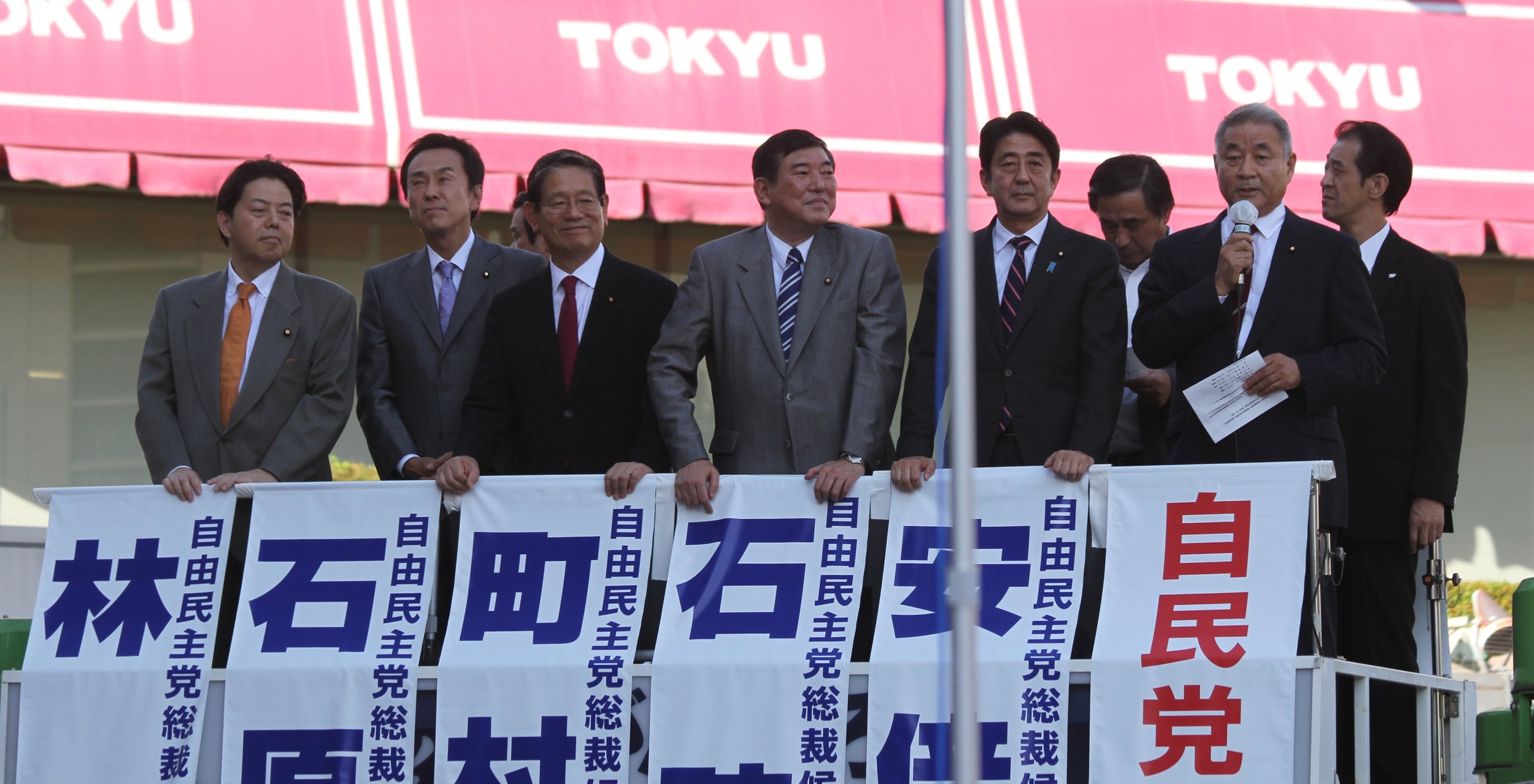
Past Liberal Democratic Party (LDP) leadership candidates, including former PMs Shinzo Abe and Shigeru Ishiba, campaigning atop a sound truck in Tokyo. This illustrates the traditional LDP electoral machinery and factional politics that have defined the 1955 System.
Key takeaways
The LDP has ruled Japan since its inception in 1955 with only two brief interruptions.
The party’s scale and well-developed electoral machinery allows it to exploit structural advantages to keep the opposition at bay.
A divided opposition has been mostly unable to mount a credible challenge to the LDP.
Growing challenges indicate that the days of LDP dominance might be coming to an end.
The Liberal Democratic Party (LDP) has ruled Japan almost uninterruptedly for 70 years, with only two brief stints in the opposition from 1993 to 1994 and again between 2009 and 2012.
Yet cracks are beginning to show. The party now finds itself on the back foot after damaging scandals and electoral drubbings in recent years. While somewhat buoyed by Prime Minister Takaichi’s popularity, a shrinking support base is a looming existential threat. Given that we’re likely to see a snap election called during 2026, this deep dive offers a perspective on how, in a democratic country with free elections, opposition parties, and an increasingly frustrated electorate, the LDP has managed to remain in power.
1. A brief history of the Liberal Democratic Party
The LDP emerged in the wake of the American Occupation of Japan following the country’s defeat in World War II. Facing a reunified Japan Socialist Party and with encouragement from the CIA, the two main conservative parties decided to merge in order to present a unified front. The Liberal Party and the Japan Democratic Party merged in 1955 to form the Liberal Democratic Party, which would go on to enjoy a majority in government until 1993. This period became known as the 1955 system.
What is the 1955 system?
The 1955 system is the period of one-party dominance that prevailed in Japan for over 38 years, in which the LDP enjoyed supremacy in government. During this time, the opposition was incapable of challenging the ruling party. However, several scandals and unpopular policies tarnished the LDP, leading it to lose its majority in the Upper House in 1989, a prelude of more pain to come.
With the bursting of the Japanese asset price bubble in the early 1990s, the LDP received the brunt of public dissatisfaction in the 1993 Lower House election, losing its governing majority for the first time in 38 years. Despite remaining the largest party, the LDP was replaced by a rainbow coalition of moderates and reformists, including a renegade band of its own lawmakers. While this uneasy alliance didn’t last long, the political reform it implemented paved the way for the birth of the Democratic Party of Japan (DPJ), which wrestled control of the government from the LDP in 2009 only to relinquish it back in 2012.
While for many observers the 1955 system ended in 1993, others consider that it continues to this day, given that LDP-led governments are still the norm. However, the party no longer enjoys supremacy and has leaned into coalitions to maintain power, first with Komeito and currently with the Japan Innovation Party (JIP). Under this arrangement, the 1955 system is also known as the one-and-a-half party system.
2. Why has the Liberal Democratic Party dominated Japanese politics?
The LDP’s dominance is the result of a combination of factors, including structural advantages, an ineffective opposition, and mere chance.
A hapless, divided opposition
When the DPJ ousted the LDP from government in 2009, it looked like Japan had finally achieved a form of bipartidism similar to that in the U.S. However, such hopes soon proved premature.
After taking power, the DPJ was beset by infighting and struggled to bring many of its policies into fruition, while also managing to alienate the powerful Japanese bureaucracy that effectively runs the government. On top of that, the party had the misfortune of being in charge in March 2011 when the Tohoku earthquake and tsunami (and the resulting Fukushima nuclear accident) struck. The crisis was the last straw that paved the way for the LDP’s return to power the following year.
The DPJ would undergo on into a series of mergers and splits in the years that followed, finally splintering into two parties that survive today: the Constitutional Democratic Party (CDP) and the Democratic Party for the People (DPFP), which are at odds ideologically. The CDP in particular, which is the largest opposition party and which retains the bulk of the DPJ’s left wing, has struggled to shake off the stain of the DPJ’s government record, preventing them from becoming a viable alternative to the LDP in the eyes of voters.
The DPFP and other opposition parties remain largely hostile to cooperation and mergers due to ideological differences, further ensuring the LDP continues to be the largest party.
The LDP’s trump card: A well-greased electoral machinery
The main advantage the LDP has over the opposition is the massive vote-generating machines it has nurtured over decades, and that until recently included the similarly reliable Komeito apparatus. The purpose of these machines is building a long-term support base that consistently and reliably brings voters to the polls every single time. Since the party can count on these loyal voters to show up in every election, Japan’s infamous low voter turnout actually benefits the LDP.
The vote-getting machinery works through two main avenues:
A comprehensive bureaucratic network that connects municipalities to the central government, delivering targeted benefits to constituencies, often in the form of pork barrel spending.
Individual support groups (known as koenkai) that drum up support for candidates and mobilize voters in their respective areas.
The LDP has over one million registered members in local chapters across all prefectures, and the loyalty of a large share of support groups. The opposition, fragmented and mostly consisting of newer, smaller parties, simply doesn’t have the scale, resources, or connections to compete.
The LDP also enjoys structural advantages within the Japanese electoral system, which it has used to maximize the effectiveness of its vote-getting machinery:
Short campaign periods. Compared with countries like the U.S., electoral campaigns in Japan are quite short, which favors candidates that can rely on a big promotional push from an established party.
High barrier of entry. To run for the Lower House, a candidate must deposit ¥3 million for a district seat and ¥6 million for a proportional representation seat, which is lost unless a certain number of votes is achieved. Smaller parties don’t have the funds to cover deposits for as many candidates.
Election unpredictability. Since the prime minister can dissolve the Lower House anytime, opposition parties have a hard time organizing and preparing for elections.
Will the LDP continue to dominate?
The LDP faces an uphill battle to retain its dominant position. Its traditional support base in rural areas is aging and shrinking, while regular scandals continue to damage its reputation. Most of all, the breakup with longtime coalition partner Komeito means the LDP has lost access to Komeito’s vote-generating machine: Soka Gakkai, the Buddhist movement that claims over 8 million members in Japan. Potential clashes between JIP and LDP members over the domain of Osaka add further tension points to the tenuous coalition, with smaller parties like the Sanseito and the DPFP nibbling away at the conservative bloc of voters that formerly consisted of the LDP’s base.
The LDP is struggling to keep the comfortable position it has enjoyed for decades, but a popular prime minister might be exactly what it needs to regain its footing. When Takaichi inevitably dissolves the Lower House in the near future, we will see how the LDP’s electoral machinery fares in light of all the recent setbacks, chief among them the loss of Komeito. Will she be able to turn the tide and manage a majority in the Lower House, or will she continue along the trodden path of minority victories like in the 2024/2025 elections? Only time (and polling) may tell.
If you found this overview useful and want more regular insights into Japan’s politics and public policy, sign up to our mailing list and stay ahead of the developments shaping Japan’s future.
Photo Credits
Presidential election speech of the Liberal Democratic Party in Nagano
By TTTNIS - Own work, CC0, https://commons.wikimedia.org/w/index.php?curid=21375534